Thursday, May 23, 2024

The Birth of Two Crops!

May 23

Update on my personal linen flax plot

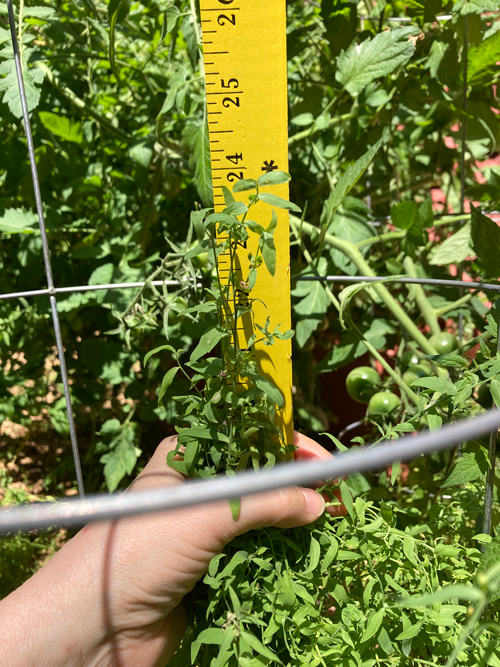
My linen flax crop is now one month old and growing vigorously. It started out slowly, probably due to the cooler weather when it germinated, but now it is growing at a rate of about an inch a day! We are getting pretty regular rainfall, so I've rarely needed to water the plot. The air temperature has been gradually getting warmer, but overall, we have had a cooler spring. Both are keen factors in growing happy linen flax. Yesterday, the longest stalks measured 6 inches in height, and today, they are 7 inches. One inch a day? Wow! Happy flax! 


Image of flax stalks with measuring stick showing 7 inches in height.

I kept the plot regularly weeded until about two weeks ago when the majority of the stalks were getting too tall for such disturbance. The plot is pretty weed-free at this point. The area that was somewhat washed out by an early plot flooding has not been lost. It is simply a bit behind in growth. So, somehow, the seeds remained in place even with the flooding. Perhaps that is also a factor of the careful raking that I did during the sowing. It is interesting to see the seeds are so vigorous, even under duress.


My ongoing concern is that my plot does not have continuous sunlight throughout the day, especially now that the trees have fully leafed out. I guess I will have to wait and see if that becomes a factor in the overall stalk length. Having the Gale Woods flax to compare it to (they planted the same Avian variety of linen flax, but in full sunlight) will be interesting.


Image of Blue Flax flower in grasses

A side note:
I planted a perennial variety of flax (Blue Flax) a few years ago, and it is already in bloom! This variety has multiple branches with multiple flowers, is quite short at its full height (maybe 10 inches tall), and, therefore, is not a good linen fiber flax. It is found in garden centers and is the type of flax you can commonly find in a seed packet. But it is still very beautiful!


Update on the Gale Woods Farm linen flax plot 

The seeds sown at Gale Woods Farm started to pop through the soil at around the 7-day mark. 


Small linen flax seedlings in plot at Gale Woods.

Now, they are two weeks into their growth, and some are developing their second and third leaf sets. Some areas have been slower to germinate, probably due to being raked deeper in the soil, but even those areas now have seedlings that are starting to emerge. I expect that in one more week, most of the crop will be well on its way. The bulk of the plants are at the height of a first weeding, so today, I went over to the farm to weed them. 


People on hands and knees pulling out weeds from flax plot.

Happily, the crew that was part of the seed sowing was there, and they came over to help weed the plot. What a wonderful help they are! It was weeded in no time. The worst of the weeding right now is with large thistle plants that are really trying to make their mark in the plot. I suspect we will be dealing with those nasty guys for a while. I will return next week to do another weeding and check the flax stalk growth.


Wednesday, May 8, 2024

Sowing Linen Flax Adventures in 2024!

I am not very consistent with this blog. I can't believe over a year has passed since I put something up here. 

A lot has been happening with me and linen flax since I received the American Swedish Institute Teaching Tools Grant for acquiring (and creating) linen flax processing tools. I've had three sold-out flax processing workshops at the ASI over the past year, one sold-out flax spinning class at ASI, demonstrated flax processing at the ASI midsummer event, presented on the subject of linen flax to the Minnesota Landscape Arboretum, and gave a presentation and demonstration on linen flax to nearly 80 attendees at the Weavers' Guild of Minnesota. Whew! That, plus more research into the historical and biological aspects of linen flax, has kept me busy and given me more knowledge of the subject to the point that I wanted to dig deeper this year, literally deeper, into linen flax.

So, last fall, I purchased more linen flax seeds from the Landis Valley Heritage Museum in Pennsylvania. Receiving this pound of seed (Avian variety) put urgency into me to find a place to grow the seed in the spring of 2024. Nothing like finding something to kick you in the butt!

In the past, I taught and volunteered in the fiber program at Gale Woods Farm, an educational farm part of the Three Rivers Park District in Minnesota. In the winter, I approached the farm staff to see if I could kick-start a linen flax crop this spring. When they saw the possibilities of this fitting into their sustainability programming, it was a “Yeah! Let's do it!"

I also wanted to have a personal plot with part of the seed I purchased to record the entire growing process daily. Therefore, between the two growing projects for this summer, my refresh of the Saga Hill blog begins as a way to record this year of linen flax!

My personal home plot begins

To respect nature's calendar year, I looked at the Bloodroot plant that grows in our home woods. Its blooming is always a sign that true spring has arrived. Even if the weather might get cold and even snow, which it did, I have never seen any major cold events happen after the Bloodroot blooms. This year, it bloomed a good two weeks before prior years. So, I used that as my guide for sowing my linen seeds. Onward! 

The technical details of my home plot…

Plot size: somewhat triangular, roughly 6 x 7 (42 square feet).


Date sown: 4/15/24. This date was chosen because the Bloodroot in the nearby wooded area is now in bloom, which has been an early sign of true spring here. (This is about two weeks before its bloom date in previous years.)

Time sown: 4 PM

Weather: 66 degrees, partly cloudy, rain in the forecast

Soil temp: did not test, although nearby farm had a soil temp of 40 degrees nearly 2 weeks ago. According to University studies, 40­–50 degrees is supposedly the ideal temperature for flax sowing (although that may be for seed and straw flax).

Soil: Loamy, raked up 3x to a fine consistency

Sown: 4 ounces

Sowing method: Broadcasting from a cup. Criss-crossed plot to densely cover the entire area. Then stepped down and watered. Some seeds remained on the surface. Reworked soil with a fine rake so more seeds would drop into the soil.


I placed a wooden grid and some sticks over the plot to try to keep the dog and some critters out. Keeping ground squirrels out will probably be my biggest challenge.


For the following 48 hours, there was a LOT of rain, and the north part of the bed was flooded. I will wait to see if any seeds germinate before re-seeding it in that area.


From 4/15 to 4/25, some nights had 33-degree temperatures, perhaps briefly below freezing, too. There has been considerable rain during this period. I only needed to water the plot once around 4/23.


4/26/24 – (12 days since sowing) The first sign of emerging plants! I put sticks over the plot to discourage our dog and other critters from stepping on the area.


image of small flax plants growing in soil

4/30/24 – It appears that most of the seeds have germinated. The partial flooding of the plot and the early cold weather don’t seem to have affected the germination in any obvious way. The north end of the plot is more prolific than the south end. That may be because, right now, the north end gets a little more sun. The sun exposure for the entire plot will increase up to midsummer. Interestingly, it took longer for the seeds to germinate than those I have sown during warmer weather in previous years (particularly on the 20th of May, 2023). The photo below shows that more seeds have germinated from the initial emergence. I removed the sticks and now have a fence around the plot.
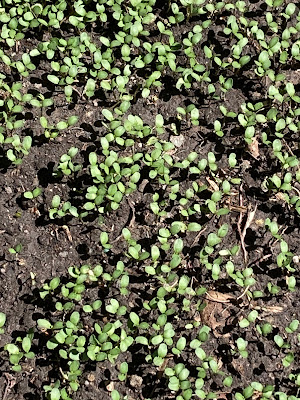

Taller flax plants in soil
 

5/8/24 – (4th week since sowing—the date of this blog post) The seeds have grown to a height of about 1 inch in general. Since the 30th of April, there has been rain nearly every other day, so I have not had to water the plot yet. The sun is more centralized over the plot, although the nearby trees are also leafing out, leading to a shorter amount of direct sun in the course of a day. Our property has so many trees, which is another reason I sought out Gale Woods Farm as another plot test. So far, weed growth is minimal.


The Gale Woods plot begins

May 8, 2024 – we sowed 1.5 pounds of linen flax seeds at Gale Woods Farm this morning!

The garden supervisor managed to corral three staff and one volunteer to help with the sowing. Approximately 150 linear feet of linen flax (Avian variety) was sown by 11 AM on this gorgeous spring day, with an air temperature of around 65 degrees and a very light breeze. Between the six of us, it only took about 45 minutes to finish the job: from raking the soil to a finer consistency (“as fine as snuff,” as the Swedes say), distributing and broadcasting the seeds with our hands from cups, and raking the seeds into the soil. Efficiency comes in numbers! Now we wait for a potential rain this evening, or the garden supervisor will sprinkle a little water on the seed bed tomorrow morning. It was interesting to see the seeds shining in the sun before the final raking, knowing that more raking was needed if we saw any seeds shining. Crossing my fingers that we see the plants emerging in about a week!

Here are some images from the Gale Woods sowing:

Plowed field row with people raking the soil

The initial raking of the plot row. The plot is 4 feet wide with 2 feet on either side for walking.


We distributed the seeds into cups to broadcast them evenly in the plot row.


A person throwing the seeds onto the plot row.

The seeds were broadcast (thrown) onto the plot row. To ensure the seeds were consistently sown along the row, each person had four ounces of seeds to spread within their zone. Linen flax requires a tight density of plants—as many as 2000 seeds per square yard!


Several people raking the seeds into the plot row.

The final step was to rake the seeds into the plot row. The seeds only need to be sown about 1/2 to 1 inch into the soil, and a gentle raking is a very efficient method of achieving this.


Friday, November 4, 2022

’Tis the End of a Season

Time to review the potted flax adventure of the summer of 2022. It was interesting. That is the Minnesota way of saying, uh, maybe not so good. The crop ended up being unimpressive. Although I did get some flax stalks, they are nothing like a crop produced in full sun in a field. Surprisingly, there were also very few flowers. All in all, it wasn’t very happy flax.

It’s hard to see in this image, but the ultimate height 
of the potted flax was no more than 30 inches. 
That’s several inches shorter than flax planted in a field.

...even though the crop was well-supervised by this little frog!

And the final result! Harvested flax from the pots.
They are short, fairly curly flax stalks with the most delicate of roots.

Even with the “meh” results, it was a good learning experience. I will still dry, ret, and use this flax, so keep in touch on that progress.

In the end, I have concluded that flax is best grown in a field, free to blow and bend in the wind, supported by others of its kind. (When you consider it, we aren’t so different from flax stalks. If you keep us bound, without the freedom to become who we are meant to become, we stagnate and become less of who we could be!)

I am seeking a small plot of sunny land for next summer, where the flax may grow tall and flourish. Please get in touch with me if you have such a plot. A spot in a plowed field (about 20 x 20 feet just for management purposes) and at the western edge of the Twin Cities metro would be my ideal site.

Next post. . . more about my ASI Teaching Tools Grant work.


Thursday, September 15, 2022

Patience is Virtuous!

And quite successful. Although it took a full two weeks, the flax is retted! 

Here is the final view of the nasty, smelly pool just before I took out the flax to test it:

Flax retting in a blue puppy pool, in dark, tea-colored water.
You cannot even see the flax through the "tea" water of bacteria
and other decaying matter.

The next step was to drain the water. 

Retted flax lying in the drained puppy pool
Yes, the flax was indeed submerged, soaked through and through.

But look at how pretty it became when it was rinsed!

Close-up image of retted and rinsed flax
It's a lovely, natural flax/linen color. 
No longer stinky either!

The next step is to let it dry. Then it's ready for further processing (braking, scutching, and hackling) into spinnable fiber!

I'm sure that those of you who want to try this for yourself would appreciate a peek at what a retted flax stalk should look like, so here's a video in which I've rubbed and broken a stalk to show how the retting breaks down the outer casing of the flax to reveal the fiber threads beneath:


I still need to update you on the ongoing progress with my ASI Teaching Tools Grant. Next post, I promise!


Thursday, September 1, 2022

Ret = Rot = Patience

So much has advanced with my ASI Teaching Tools Grant project! But today, I want to share some photos from my first attempt to pool-ret a flax crop. (My first attempt at retting flax occurred over a winter season as a "snow-retting" and left a great deal to be desired.) 

A friend with a farm down the road gave me his dried, but not retted, flax crop which he grew as a test crop a few years ago. As the summer winds down, this gift has become a great opportunity to experiment with pool retting before diving into my potted flax crop processing. So, last Saturday, August 27th, I got out the puppy pool (a hard-sided, portable pool) and the entire gifted crop (just a few handfuls of flax stalks) to begin an experiment with retting the stalks.

First, an explanation of the word "ret." In Swedish, "ret" translates to "rot." And that is exactly what needs to happen to the outer matter of the flax stalk to allow the strong, spinnable fibers to be released from the stalk. Retting can be done by soaking the flax in a pond or stream (or a puppy pool), by laying it out in dewy grass for a few days to weeks, or through chemical means, which is a process left to commercial flax mills—although, ironically, chemicals, even though they are more controllable, are not an ideal way to ret it and can even damage the fiber. Flax likes to keep things close to the earth!


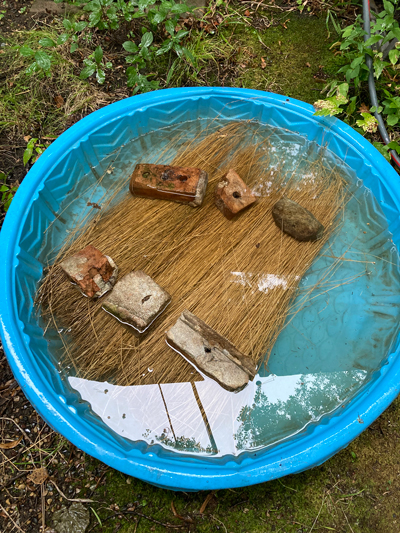
Fortunately, the pool was just the right size for the stalks.


I used bricks to keep the stalks submerged.

The process can take from 5 days in ideal, warm conditions, to perhaps 2 weeks. Our property is heavily wooded, so sunlight is not very available. Therefore, the pool water has remained cool to barely lukewarm. I think a warmer environment would be beneficial, yet I also consider areas of the world where flax is retted in streams and ponds, such as Ireland and Scotland, where a cool climate reigns. The retting will take longer in cooler waters, but it will still happen, so I'm not concerned. Let time do its thing!


Here is the retting flax after 3 days. The water has turned the color of English tea—and horribly stinky! You can see that the biological matter in the stalks is breaking down through the water's foaming. The foaming becomes even more dramatic as I exchange some of the water for fresh, which should be done every day to every few days.

I am testing the flax daily to see the retting progress. To do that, I pick out a stalk to bend and manipulate. You know the flax is ready to pull out of the bath when the outer skin starts sloughing off and revealing the flax "threads" beneath. I'll post photos of what that should look like when it happens. Today is the 5th day in the retting process, and the stalks are still quite intact. Patience is needed! 

My next post will be an update on the flax pots and the ASI teaching tools grant progress. Much has happened in those areas. But for today, I will let retting flax ret!


Friday, August 19, 2022

 It Works! She lives!

Image of a wooden flax brake with flax placed on top.

What you see here resting on my outdoor worktable is a prototype of a fully functioning tabletop Flax Brake! I am thrilled! This will now serve as my working (yay!) guide for making the final maple brake for the American Swedish Institute Teaching Tools Grant I received early this summer.

Check out the product of the first test—properly broken flax stalks!

Image of hand holding broken flax

I plan to cut the maple wood for the final brake at my husband's friend's workshop sometime in the next month and do my magic to create a fully functioning, gorgeous maple flax brake that will serve my students—and me for flax processing demonstrations—for years to come.

It's built to last. I chose to use screws rather than dowels for the construction since wooden dowels tend to shrink and expand with the changing seasons, which erratically loosens and tightens connections. I also decided to use a strong metal piano hinge for the pivot rather than a large dowel because the weakest point in both of my vintage brakes has been the wooden pivot dowel. This brake should stand the test of time—and the use of many hands!

Hackle News

I just learned that the three hackles, which are the other tools I requested in my grant application, are coming in from the UK next week. (A site in the UK was the only place I located that still makes a properly graduated set of three flax hackles.) I'll post the news and photos when I have the hackles in hand.

Flax News

Sorry. Nothing new to share on the flax plant front. They are still growing, albeit slowly, in the pots, but a few stalks are starting to yellow. Their growing season should be ending soon, with drying and harvesting to follow. Perhaps I'll have more to share about the plants in my next post.


Thursday, August 4, 2022

Growth with the Project—in more ways than one!

It's been a few weeks since my last post, but this lapse has only been due to being too busy to post. The accident I had nearly a month ago also kept me from working on the prototype for a couple of weeks. But since then, I've been in mad creation mode! 

Each piece is connected by wood screws 
in an attempt to make a really strong flax brake 
that will stay strong in all seasons (to avoid the 
seasonal shrinking and expanding of typical wood 
dowel connections) and to withstand heavy use by students.


The prototype is nearly finished! Last Sunday, 7/31/22 (my goal date for having the prototype done—I nearly met that date and would have if not for my accident), I screwed together all sections to test the general fit. 

Here's the built prototype sitting in front of its purpose, the flax,
before pulling the brake completely apart to cut the blades.

On Monday, 8/1/22, I was in a friend's woodworking shop to create the blades' angled cuts. Of course, I forgot to take photos of the action in the workshop. Perhaps I'll remember photos when cutting the final maple brake. Nevertheless, here's a photo of what the angled blades look like from a side perspective:

I still need to soften the wood edges at the top of the blade angles
to allow the blades to break the flax without cutting it.

Now, an update on the flax growing experiment…


The flax has not grown substantially in height during the past few weeks.
The average flax stalk height is now 24 inches. The smaller black pots
are still lagging behind, with some being pretty short and stagnant in their growth.

It's possible the stalks may grow taller in the next month since they can reach 3 to 4 feet tall in perfect growing conditions (a field with full sun). The challenge here is they are growing in pots, which is perhaps not ideal, and the adjacent tomato plants have also been taking over their direct sun. Today, I moved the flax to a more ideal location away from the tomatoes, so now there is less competition with the sun. I'll see if that makes a difference in their future growth. There have been a few more flowers, although they have not been prolific. Perhaps that means there is more growth to come!